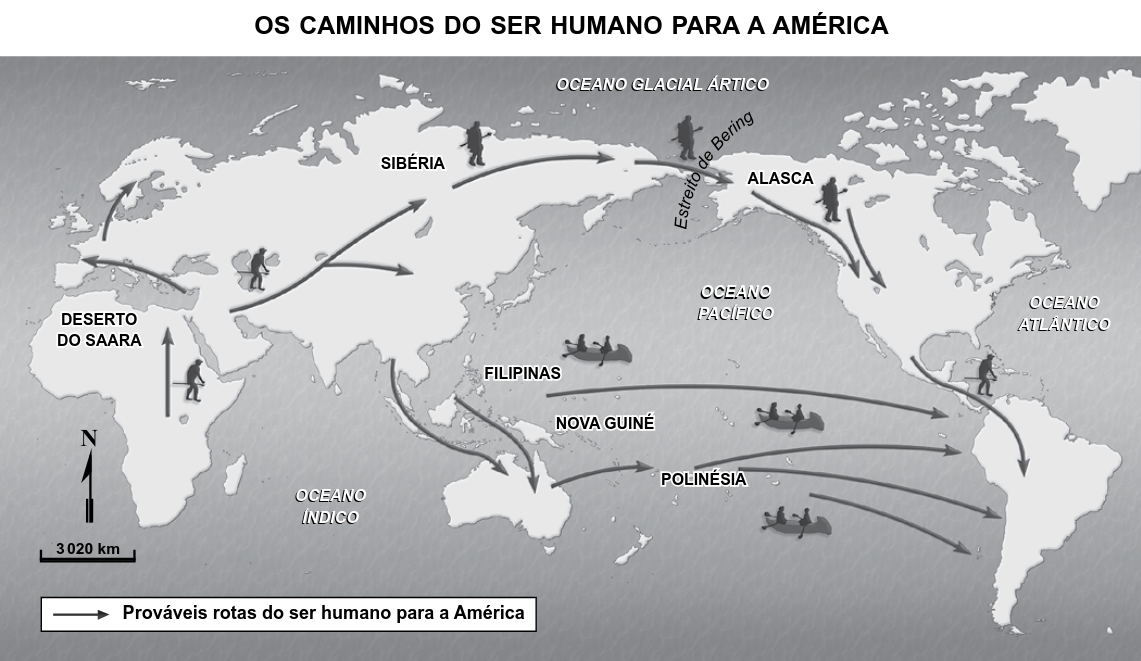
A leitura do mapa permite concluir, corretamente, que
Caderno de prova · 2024/2
A prova objetiva aplicada no vestibular da Fatec para ingresso no 2º semestre de 2024, com os 54 enunciados reproduzidos na íntegra. Leia a prova inteira aqui, de graça e sem criar conta.
O gabarito e a correção automática ficam com quem responde as questões dentro da plataforma.
A leitura do mapa permite concluir, corretamente, que
A expressão América Latina está mais associada a questões econômicas e sociais dos países que a compõem do que a um aspecto meramente territorial. Não se trata de um continente, mas, sim, de uma alusão aos 20 países da América colonizados, principalmente, por Espanha e Portugal. Territorialmente, compreende quase toda a América do Sul e Central, mais especificamente: Argentina, Bolívia, Brasil, Chile, Colômbia, Costa Rica, Cuba, El Salvador, Equador, Guatemala, Haiti, Honduras, Nicarágua, Panamá, Paraguai, Peru, República Dominicana, Uruguai e Venezuela. O México, localizado na América do Norte, também a integra. Países como Guiana, Suriname, Jamaica e Belize não a integram.
Assinale a alternativa em que é apresentado um país da América Latina cujo nome tem o maior número de anagramas.
A expressão América Latina está mais associada a questões econômicas e sociais dos países que a compõem do que a um aspecto meramente territorial. Não se trata de um continente, mas, sim, de uma alusão aos 20 países da América colonizados, principalmente, por Espanha e Portugal. Territorialmente, compreende quase toda a América do Sul e Central, mais especificamente: Argentina, Bolívia, Brasil, Chile, Colômbia, Costa Rica, Cuba, El Salvador, Equador, Guatemala, Haiti, Honduras, Nicarágua, Panamá, Paraguai, Peru, República Dominicana, Uruguai e Venezuela. O México, localizado na América do Norte, também a integra. Países como Guiana, Suriname, Jamaica e Belize não a integram.
Considere os conjuntos:
• X = {x | x é um país da América Latina};
• Y = {y | y é um país cujo idioma oficial não é o espanhol}.
Se um país pertence ao conjunto C = Y - X, então, geograficamente, esse país
A América Latina é uma região rica em biodiversidade, abrigando uma grande variedade de espécies de mamíferos, como as capivaras (Hydrochoerus hydrochaeris), maiores roedores vivos do mundo.
Entre as características que pertencem exclusivamente à classe dos animais citados no texto, destaca-se corretamente a presença de
Colônia espanhola até o final do século XIX, o país conquistou a independência em 1898, com a intervenção dos Estados Unidos, país do qual passou a ser praticamente um quintal. A influência de empresas estadunidenses ali cresceu consideravelmente ao longo do século XX. A ascensão de Fulgêncio Batista ao poder e a instalação de uma ditadura, que perseguiu opositores e implantou a censura para atender aos interesses estadunidenses, foram responsáveis por iniciar um movimento revolucionário de oposição.
O texto faz referência à
O Canal do Panamá é uma construção de aproximadamente 82 km de comprimento, criado para facilitar o comércio marítimo mundial pela ligação dos oceanos Pacífico e Atlântico. O canal permite que os navios evitem a longa rota de, aproximadamente, 19 000 km, que passa pelo Cabo Horn. Essa trajetória ocorre em torno da ponta mais meridional do continente americano, onde ventos fortes, correntes marítimas frias e icebergs fazem dessas águas uma das mais difíceis do mundo para navegação. Durante a realização da obra do canal, devido a uma diferença de nível entre o continente e os oceanos mencionados, foi necessária a construção de diversas eclusas e comportas. Para atravessar esse canal, um navio pode levar entre 6 e 10 horas. A França iniciou a construção do canal em 1881, e a abandonou em 1889. Entretanto, para alcançar seus interesses geopolíticos e econômicos, os Estados Unidos incentivaram a independência do Panamá em relação à Colômbia. Após esse evento, de 1903 a 1914, os Estados Unidos concluíram a obra e controlaram o canal até 1999, quando a administração foi transferida para o Panamá.
Segundo o texto, é possível afirmar corretamente que a mencionada obra de engenharia atingiu seu propósito por meio de construções de eclusas e comportas, que se baseiam
O Canal do Panamá é uma construção de aproximadamente 82 km de comprimento, criado para facilitar o comércio marítimo mundial pela ligação dos oceanos Pacífico e Atlântico. O canal permite que os navios evitem a longa rota de, aproximadamente, 19 000 km, que passa pelo Cabo Horn. Essa trajetória ocorre em torno da ponta mais meridional do continente americano, onde ventos fortes, correntes marítimas frias e icebergs fazem dessas águas uma das mais difíceis do mundo para navegação. Durante a realização da obra do canal, devido a uma diferença de nível entre o continente e os oceanos mencionados, foi necessária a construção de diversas eclusas e comportas. Para atravessar esse canal, um navio pode levar entre 6 e 10 horas. A França iniciou a construção do canal em 1881, e a abandonou em 1889. Entretanto, para alcançar seus interesses geopolíticos e econômicos, os Estados Unidos incentivaram a independência do Panamá em relação à Colômbia. Após esse evento, de 1903 a 1914, os Estados Unidos concluíram a obra e controlaram o canal até 1999, quando a administração foi transferida para o Panamá.
Com base no texto, é correto afirmar que
O Canal do Panamá é uma construção de aproximadamente 82 km de comprimento, criado para facilitar o comércio marítimo mundial pela ligação dos oceanos Pacífico e Atlântico. O canal permite que os navios evitem a longa rota de, aproximadamente, 19 000 km, que passa pelo Cabo Horn. Essa trajetória ocorre em torno da ponta mais meridional do continente americano, onde ventos fortes, correntes marítimas frias e icebergs fazem dessas águas uma das mais difíceis do mundo para navegação. Durante a realização da obra do canal, devido a uma diferença de nível entre o continente e os oceanos mencionados, foi necessária a construção de diversas eclusas e comportas. Para atravessar esse canal, um navio pode levar entre 6 e 10 horas. A França iniciou a construção do canal em 1881, e a abandonou em 1889. Entretanto, para alcançar seus interesses geopolíticos e econômicos, os Estados Unidos incentivaram a independência do Panamá em relação à Colômbia. Após esse evento, de 1903 a 1914, os Estados Unidos concluíram a obra e controlaram o canal até 1999, quando a administração foi transferida para o Panamá.
Antes da construção do canal, um navio cargueiro, que fosse do ponto Atlântico do Canal do Panamá até o ponto Pacífico desse canal, precisaria passar pelo Cabo Horn, conforme descrito no texto.
Suponha que esse navio conseguisse percorrer o trecho, citado no parágrafo anterior, navegando, sem paradas ou intercorrências, a uma velocidade média de cruzeiro de aproximadamente 20 nós.
Adotando 1 nó como 1,9 km/h, é correto afirmar que o navio faria essa viagem, aproximadamente, em
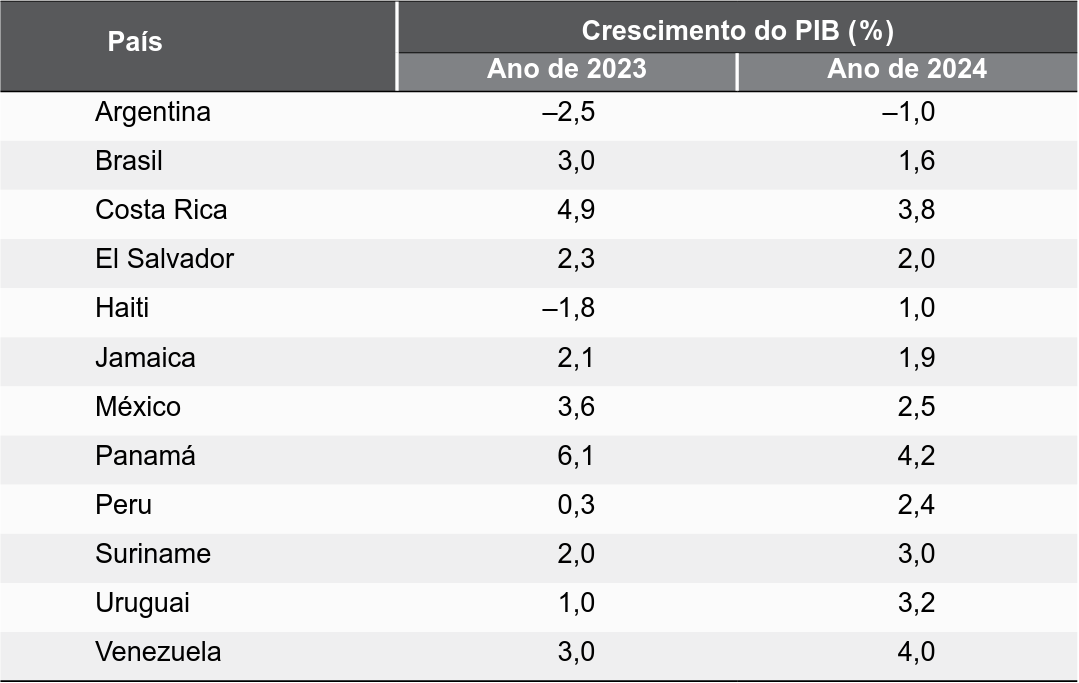
A Comissão Econômica para a América Latina e o Caribe (CEPAL) apresentou, em seu último relatório anual, as projeções atualizadas para o crescimento do PIB dos países da região da América Latina e do Caribe. A tabela apresenta essas projeções para alguns dos países dessa região.
Se considerarmos apenas os países dessa lista que fazem parte da América do Sul, podemos calcular a média aritmética referente à projeção do crescimento percentual desses países para o ano de 2024.
Assinale, dentre as alternativas apresentadas, aquela na qual há um país da América do Sul cujo crescimento do PIB, em 2024, é mais próximo de M.
A Comissão Econômica para a América Latina e o Caribe (CEPAL) apresentou, em seu último relatório anual, as projeções atualizadas para o crescimento do PIB dos países da região da América Latina e do Caribe. A tabela apresenta essas projeções para alguns dos países dessa região.
Considere que o PIB da Venezuela, no ano de 2022, foi estimado em cerca de US$ 196 bilhões. Então, de acordo com as previsões da CEPAL, a projeção para o ano de 2024, em bilhões, deve ser próxima de
A Comissão Econômica para a América Latina e o Caribe (CEPAL) apresentou, em seu último relatório anual, as projeções atualizadas para o crescimento do PIB dos países da região da América Latina e do Caribe. A tabela apresenta essas projeções para alguns dos países dessa região.
A partir dos dados apresentados no quadro, o país que teve a maior variação percentual no crescimento do PIB, de 2023 a 2024, foi
O termo "república de bananas" foi cunhado pelo escritor estadunidense William Sydney Porter, no conto O Almirante, de 1904. A história do conto se passa na Anchuria, país fictício descrito pelo autor como "uma pequena república de bananas". Acredita-se, porém, que Porter tenha se inspirado em Honduras, onde morava quando escreveu a história.
Até o fim do século XIX e começo do século XX, algumas empresas estadunidenses começaram a fazer plantações de bananas em série e criaram enclaves modernos em repúblicas da América Central. As 'repúblicas de bananas' eram literalmente os países produtores de bananas e, com isso, dependentes da renda de empresas estadunidenses.
O termo acabou ganhando um significado mais amplo ao migrar para os estudos políticos. A expressão passou a fazer referência a países marcados pela monocultura, dotados de instituições governamentais fracas e corruptas, onde uma ou várias empresas estrangeiras têm o poder de influir nas decisões nacionais.
O que chama a atenção é que os anglo-saxões não aplicam a expressão a países que estejam fora da América Latina.
De acordo com o texto, é correto afirmar que
Latin America in 2024
Despite mediocre growth, political risk is declining and cautious optimism is increasingly warranted.
SÃO PAULO — Despite a challenging macroeconomic and geopolitical scenario, 2023 was not a bad year for Latin America. Throughout the past twelve months, a cautiously optimistic outlook among analysts has become increasingly common. Economic growth in 2023 is expected to end up at 2.2% — somewhat better than the 1.7% initially projected, but still below the global average of 3.2%. Most analysts expect growth to decline slightly to 1.9% this year, too little to decisively overcome the deep-seated public discontent that has been so prevalent across Latin America in recent years.
A partir da leitura do texto, infere-se que, na América Latina,
Latin America in 2024
Despite mediocre growth, political risk is declining and cautious optimism is increasingly warranted.
SÃO PAULO — Despite a challenging macroeconomic and geopolitical scenario, 2023 was not a bad year for Latin America. Throughout the past twelve months, a cautiously optimistic outlook among analysts has become increasingly common. Economic growth in 2023 is expected to end up at 2.2% — somewhat better than the 1.7% initially projected, but still below the global average of 3.2%. Most analysts expect growth to decline slightly to 1.9% this year, too little to decisively overcome the deep-seated public discontent that has been so prevalent across Latin America in recent years.
A palavra Despite, no texto, é usada para
No extremo sul do Chile, foi inaugurada, em 2022, a primeira planta industrial do mundo para produção de combustíveis ecológicos. O processo utiliza dois recursos: o vento e a água, que são abundantes na região.
O vento é responsável pela geração de energia elétrica limpa fornecida à usina. Essa energia é utilizada a fim de realizar a eletrólise da água para obtenção de hidrogênio, substância usada na produção do combustível sintético (denominado e-fuel).
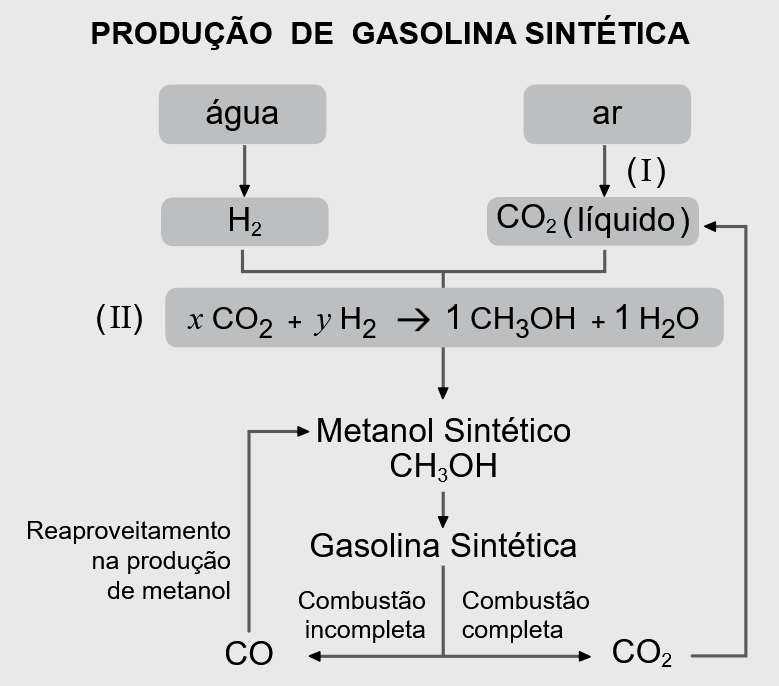
Uma estação aspira o ar atmosférico e separa o dióxido de carbono dos demais componentes do ar. Por meio de pressurizadores, condensadores e filtros, o CO₂ é armazenado no estado líquido. Feito isso, o próximo passo é reagir o CO₂ com o hidrogênio, gerando o metanol sintético que, refinado, resulta na gasolina sintética, conforme o esquema.
Assinale a alternativa que contém o nome correto da mudança de estado físico, ocorrida com o dióxido de carbono, no processo indicado em (I).
No extremo sul do Chile, foi inaugurada, em 2022, a primeira planta industrial do mundo para produção de combustíveis ecológicos. O processo utiliza dois recursos: o vento e a água, que são abundantes na região.
O vento é responsável pela geração de energia elétrica limpa fornecida à usina. Essa energia é utilizada a fim de realizar a eletrólise da água para obtenção de hidrogênio, substância usada na produção do combustível sintético (denominado e-fuel).
Uma estação aspira o ar atmosférico e separa o dióxido de carbono dos demais componentes do ar. Por meio de pressurizadores, condensadores e filtros, o CO₂ é armazenado no estado líquido. Feito isso, o próximo passo é reagir o CO₂ com o hidrogênio, gerando o metanol sintético que, refinado, resulta na gasolina sintética, conforme o esquema.
Considerando a equação química (II), que representa a reação de produção de metanol, os valores de x e y, que tornam a equação corretamente balanceada, são, respectivamente,
No extremo sul do Chile, foi inaugurada, em 2022, a primeira planta industrial do mundo para produção de combustíveis ecológicos. O processo utiliza dois recursos: o vento e a água, que são abundantes na região.
O vento é responsável pela geração de energia elétrica limpa fornecida à usina. Essa energia é utilizada a fim de realizar a eletrólise da água para obtenção de hidrogênio, substância usada na produção do combustível sintético (denominado e-fuel).
Uma estação aspira o ar atmosférico e separa o dióxido de carbono dos demais componentes do ar. Por meio de pressurizadores, condensadores e filtros, o CO₂ é armazenado no estado líquido. Feito isso, o próximo passo é reagir o CO₂ com o hidrogênio, gerando o metanol sintético que, refinado, resulta na gasolina sintética, conforme o esquema.
Um processo neutro em carbono ou de carbono neutro é aquele que não contribui para o aumento da quantidade de carbono emitido na atmosfera na forma de gases, como CO e CO₂.
Podemos concluir corretamente que a produção da gasolina sintética pode ser considerada neutra em carbono, já que, de acordo com o esquema, o hidrogênio e o dióxido de carbono são transformados em gasolina sintética, cuja
No extremo sul do Chile, foi inaugurada, em 2022, a primeira planta industrial do mundo para produção de combustíveis ecológicos. O processo utiliza dois recursos: o vento e a água, que são abundantes na região.
O vento é responsável pela geração de energia elétrica limpa fornecida à usina. Essa energia é utilizada a fim de realizar a eletrólise da água para obtenção de hidrogênio, substância usada na produção do combustível sintético (denominado e-fuel).
Uma estação aspira o ar atmosférico e separa o dióxido de carbono dos demais componentes do ar. Por meio de pressurizadores, condensadores e filtros, o CO₂ é armazenado no estado líquido. Feito isso, o próximo passo é reagir o CO₂ com o hidrogênio, gerando o metanol sintético que, refinado, resulta na gasolina sintética, conforme o esquema.
O combustível sintético emite, em sua queima, apenas 10 % da quantidade de CO₂ emitida na combustão de combustíveis fósseis.
Esta equação química balanceada representa a queima da gasolina ( C₈H₁₈ ) de origem fóssil.
Considere que um motor realizou a queima de 114 g de C₈H₁₈ (M = 114 g/mol) de origem fóssil.
Caso esse mesmo motor utilizasse gasolina sintética, a massa de CO₂ (M = 44 g/mol) emitida, em gramas, seria de, aproximadamente,

A América Latina é apontada pela Organização das Nações Unidas para Agricultura e Alimentação (FAO) como celeiro do mundo. Contudo, a produção de alimentos vem sendo ameaçada pelas plantas daninhas de difícil controle (PDDC), que são resistentes à aplicação de herbicidas e de defensivos agrícolas, constituindo um dos principais problemas à agricultura mundial. As PDDC competem com as culturas agrícolas por nutrientes, água, luz e espaço, podendo também ser hospedeiras de pragas e doenças.
Uma das espécies infestantes mais nocivas à agricultura é o capim-amargoso (Digitaria insularis), que se desenvolve rapidamente por rizomas e sementes, com alta taxa de dispersão.
Nesses casos, o controle biológico realizado com o uso de fungos fitopatógenos, microrganismos que causam doenças em plantas, tem se mostrado muito promissor, pois esses fungos promovem a inibição do crescimento das plantas de capim-amargoso e diminuem, de forma significativa, a produção de suas sementes.
É correto afirmar que o método de controle biológico, citado no texto,
Segundo a FAO, a produção de proteína animal é também considerada fundamental para a segurança alimentar da população do mundo. E, nesse aspecto, a contribuição da América Latina é importante, pois ocupa o segundo lugar mundial, perdendo apenas para a Ásia, na produção de carnes, pescados, leite e ovos.
Segundo especialistas, no organismo humano, esse tipo de nutriente desempenha várias funções biológicas importantes, como as realizadas
A cidade mexicana de La Paz e o Parque Nacional da Patagônia (PNP), no Chile, separados por quase 9 000 quilômetros, são dois lugares da América Latina que aparecem na lista dos 100 "melhores lugares do mundo" a se explorar, segundo ranking de uma revista estadunidense.
O quadro apresenta as coordenadas de tempo em GMT (Greenwich Mean Time), que são utilizadas para definir os fusos horários.
Suponha que seja possível embarcar em um voo direto entre esses dois lugares e que a aeronave faça esse trajeto com velocidade média de 900 km/h.
Se um passageiro embarcasse em La Paz às 09h45min, ele desembarcaria no PNP, aproximadamente, às

O congestionamento de tráfego é um desafio para a saúde econômica da América Latina. Investir em transporte público pode ser uma solução, uma vez que essa modalidade de transporte pode ser vista como uma maneira inteligente de usar o espaço público.
Dados apontam que um carro de médio porte ocupa 8 m² e transporta até 5 pessoas, enquanto um ônibus básico ocupa 56 m² e transporta até 70 pessoas.
Logo, para transportar simultaneamente 70 pessoas, a quantidade mínima de carros necessária é de I, o que equivale ao espaço público ocupado por II ônibus.
Assinale a alternativa que completa corretamente os espaços numerados.
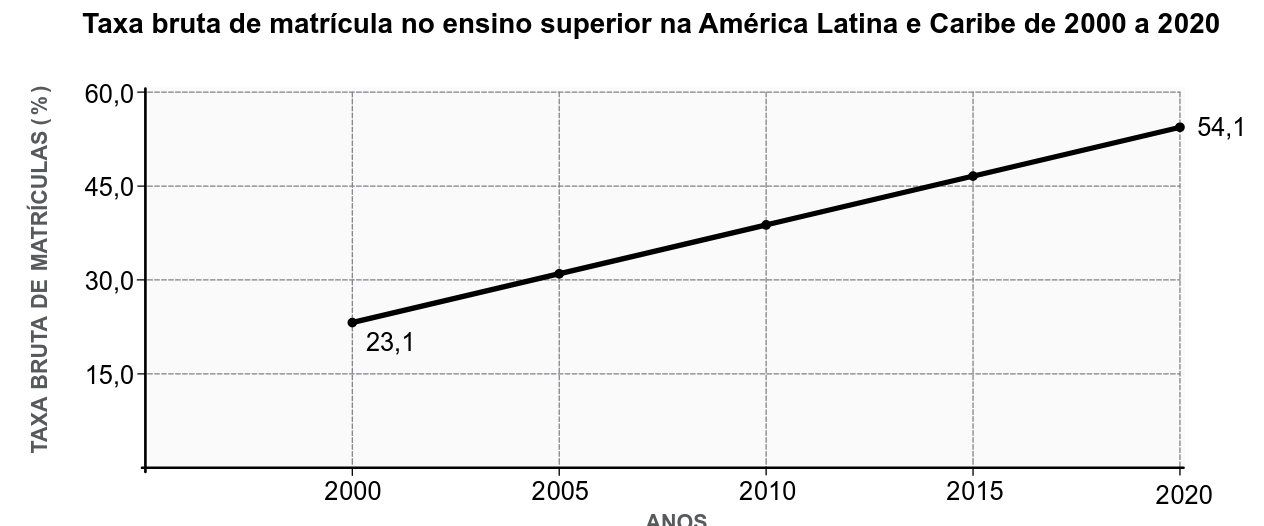
A taxa bruta de matrícula é o indicador mais usado em todo o mundo para monitorar o acesso à educação. O gráfico apresentado foi elaborado utilizando uma aproximação linear para os valores dessa taxa de matrícula no ensino superior.
De acordo com o gráfico, pode-se concluir, corretamente, que a taxa bruta de matrículas no ensino superior, estimada no ano de
A Organização Pan-Americana de Saúde (OPAS) aderiu à "Década de Ação pela Segurança no Trânsito 2021–2030" com a intenção de diminuir o número de mortes e de lesões em acidentes de trânsito.
Um dos principais motivos observados é o excesso de velocidade. Por isso, têm sido instalados detectores de velocidade. Entretanto, esses detectores precisam ser periodicamente calibrados.
Uma história clássica, ocorrida em 2021, foi a suspensão da Carteira Nacional de Habilitação (CNH) de um motoiclista que teria percorrido uma estrada a cerca de 900 km/h (≅ 250 m/s).
Suponha que ele estivesse realmente a essa velocidade e o conjunto moto-piloto tivesse massa igual a 200 kg.
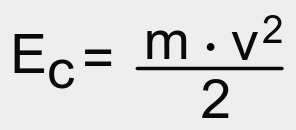
Despreze quaisquer ações dissipativas e assinale a alternativa que apresenta, aproximadamente, o valor da energia cinética, em joules, envolvida no conjunto moto-piloto no momento do registro.
Dado:
Segundo a OPAS, na América Latina, mais de 10 mil pessoas morrem, a cada ano, em consequência de complicações causadas pelo mal de Chagas, sendo que cerca de 6 a 8 milhões de pessoas convivem com essa doença, apesar de 70 % delas não saberem que estão infectadas devido à ausência de sintomas clínicos.
Para prevenir, detectar, tratar essa enfermidade e quebrar a cadeia de transmissão, é importante saber que essa doença se caracteriza por ser
A tevê dispara imagens que reproduzem o sistema e as vozes que lhe fazem eco; e não há canto do mundo que ela não alcance. O planeta inteiro é um vasto subúrbio de Dallas. Nós comemos emoções importadas como se fossem salsichas em lata, enquanto os jovens filhos da televisão, treinados para contemplar a vida em vez de fazê-la, sacodem os ombros.
Na América Latina, a liberdade de expressão consiste no direito ao resmungo em algum rádio ou em jornais de escassa circulação. Os livros não precisam ser proibidos pela polícia: os preços já os proíbem.
Segundo o texto apresentado, é correto afirmar que
A tevê dispara imagens que reproduzem o sistema e as vozes que lhe fazem eco; e não há canto do mundo que ela não alcance. O planeta inteiro é um vasto subúrbio de Dallas. Nós comemos emoções importadas como se fossem salsichas em lata, enquanto os jovens filhos da televisão, treinados para contemplar a vida em vez de fazê-la, sacodem os ombros.
Na América Latina, a liberdade de expressão consiste no direito ao resmungo em algum rádio ou em jornais de escassa circulação. Os livros não precisam ser proibidos pela polícia: os preços já os proíbem.
O uso de conotação é recorrente, no texto apresentado, devido a seu caráter literário.
Isso fica evidente na oração "o planeta inteiro é um vasto subúrbio de Dallas", que é uma
Em 1977, o Centro Médico Especializado de Ciudad Juárez adquiriu um equipamento médico para diagnóstico que continha material radioativo. Após seis anos, um técnico de manutenção, inadvertidamente, desmontou parte desse equipamento e extraiu de lá uma peça em cujo interior havia 6 mil grânulos do radioisótopo cobalto-60.
Os grânulos desse radioisótopo são minúsculos e podem ser descritos como cilindros circulares retos que possuem diâmetro e altura com a mesma medida de 1,0 mm. Todavia, mesmo pequenos, esses grânulos representam uma fonte de radioatividade cuja meia vida é estimada em 5 anos.
Aparentemente, o objetivo do técnico era vender as peças da unidade de tratamento como sucata. No entanto, a maneira como o dispositivo foi perfurado e transportado fez com que uma quantidade indefinida de grânulos fosse espalhada na caminhonete usada, nos demais veículos comerciais e até em ruas de Ciudad Juárez.
Esse é um dos maiores incidentes nucleares registrado nas Américas.
Assinale a alternativa que indica, em metros cúbicos, o volume total de grânulos do radioisótopo mencionado no texto. (Adote π = 3)
Em 1977, o Centro Médico Especializado de Ciudad Juárez adquiriu um equipamento médico para diagnóstico que continha material radioativo. Após seis anos, um técnico de manutenção, inadvertidamente, desmontou parte desse equipamento e extraiu de lá uma peça em cujo interior havia 6 mil grânulos do radioisótopo cobalto-60.
Os grânulos desse radioisótopo são minúsculos e podem ser descritos como cilindros circulares retos que possuem diâmetro e altura com a mesma medida de 1,0 mm. Todavia, mesmo pequenos, esses grânulos representam uma fonte de radioatividade cuja meia vida é estimada em 5 anos.
Aparentemente, o objetivo do técnico era vender as peças da unidade de tratamento como sucata. No entanto, a maneira como o dispositivo foi perfurado e transportado fez com que uma quantidade indefinida de grânulos fosse espalhada na caminhonete usada, nos demais veículos comerciais e até em ruas de Ciudad Juárez.
Esse é um dos maiores incidentes nucleares registrado nas Américas.
O radioisótopo cobalto-60 emite uma partícula beta negativa, transformando-se no isótopo estável níquel-60.
A alternativa que contém a equação nuclear correta para representar a emissão descrita é


Em 1977, o Centro Médico Especializado de Ciudad Juárez adquiriu um equipamento médico para diagnóstico que continha material radioativo. Após seis anos, um técnico de manutenção, inadvertidamente, desmontou parte desse equipamento e extraiu de lá uma peça em cujo interior havia 6 mil grânulos do radioisótopo cobalto-60.
Os grânulos desse radioisótopo são minúsculos e podem ser descritos como cilindros circulares retos que possuem diâmetro e altura com a mesma medida de 1,0 mm. Todavia, mesmo pequenos, esses grânulos representam uma fonte de radioatividade cuja meia vida é estimada em 5 anos.
Aparentemente, o objetivo do técnico era vender as peças da unidade de tratamento como sucata. No entanto, a maneira como o dispositivo foi perfurado e transportado fez com que uma quantidade indefinida de grânulos fosse espalhada na caminhonete usada, nos demais veículos comerciais e até em ruas de Ciudad Juárez.
Esse é um dos maiores incidentes nucleares registrado nas Américas.
Meia-vida é o tempo necessário para que a atividade radioativa de um elemento seja reduzida pela metade.
Levando em consideração que um ano possui 365 dias, verifica-se que a atividade radioativa do radioisótopo diminuiu, num período de 7300 dias, um percentual equivalente a
A partir da década de 1960, diversas empresas denominadas "maquiladoras" começaram a se instalar nas cidades do norte do México e passaram a empregar milhares de trabalhadores, que, majoritariamente, recebem baixos salários e desconhecem seus direitos mais básicos.
Essas empresas, em sua maioria, são
No século XIX, o cientista inglês Charles Darwin explorou a costa da América do Sul, da Bahia ao arquipélago de Galápagos, situado a aproximadamente 1000 km da costa do Equador. Darwin foi um dos primeiros naturalistas a explorar esse arquipélago, onde observou uma fauna e uma flora que variavam de ilha para ilha e que diferiam de outras encontradas no continente.
As inúmeras observações e pesquisas realizadas por esse naturalista desencadearam reflexões que o levaram a desenvolver suas ideias sobre a evolução da vida, as quais se basearam
Os excrementos de aves e morcegos depositados nas Ilhas Chincha, localizadas na costa Peruana, formam no solo uma espessa camada de guano. O guano pode ser utilizado como fertilizante devido à presença de compostos nitrogenados, como a amônia (NH₃).
Esta equação química representa o equilíbrio que ocorre na decomposição da amônia em nitrogênio e hidrogênio:
2 NH₃(g) ⇌ N₂(g) + 3 H₂(g)
Desse modo, considerando apenas essas conclusões, para deslocar o equilíbrio da referida equação no sentido da formação de amônia, deve-se
O químico francês Le Chatelier, estudando o comportamento de sistemas em equilíbrio quando sujeitos à variação de fatores como concentração, pressão e temperatura, chegou às seguintes conclusões:
• o aumento da concentração de reagentes desloca o equilíbrio no sentido dos produtos;
• a diminuição da concentração de reagentes desloca o equilíbrio no sentido dos reagentes;
• o aumento da pressão desloca o equilíbrio no sentido do menor volume gasoso; e
• a diminuição da pressão desloca o equilíbrio no sentido de maior volume gasoso.
Desse modo, considerando apenas essas conclusões, para deslocar o equilíbrio da referida equação no sentido da formação de amônia, deve-se
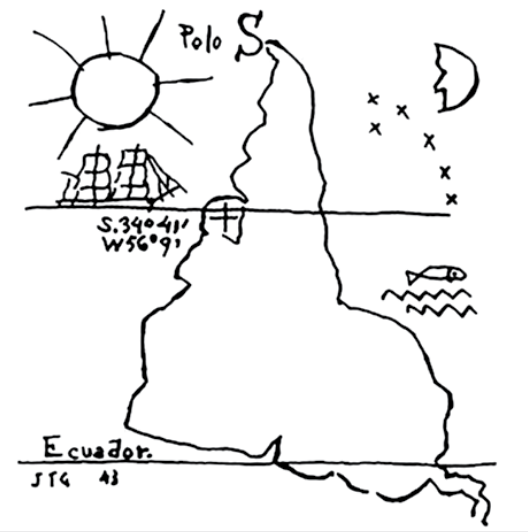
Este não é um mapa como os convencionais, QUE costumam ser validados na ciência geográfica pelo emprego de escala, legenda, título ou dados georreferenciados. Também não é uma obra de arte usual, pois visualizamos claramente uma estética ou um contorno que reconhecemos como cartográfico. Por ser tanto um mapa, quanto uma obra de arte, enquadra-se no que é chamado de mapa artístico.
Seu autor, Joaquín Torres-García, publicou-O em 1943 para inaugurar um movimento artístico inovador e original, em Montevidéu, O QUAL objetivava ser capaz de igualar a arte aqui desenvolvida à arte de Paris. Entretanto, o artista encontrou dificuldades devido ao gosto predominante nas artes uruguaias de copiar cânones estéticos importados da Europa.
Em sua obra, esse autor exaltava a cultura e os motivos do Uruguai e da América do Sul, combatendo o comportamento que ELE chamou de "exilados da Europa". Uma consciência que não era só de Torres- García, como também de outros artistas modernistas da América Latina, incomodados com as principais capitais latinas QUE não se apresentavam como sedes de sua sociedade.
No texto apresentado, o(s) pronome(s)
Este não é um mapa como os convencionais, QUE costumam ser validados na ciência geográfica pelo emprego de escala, legenda, título ou dados georreferenciados. Também não é uma obra de arte usual, pois visualizamos claramente uma estética ou um contorno que reconhecemos como cartográfico. Por ser tanto um mapa, quanto uma obra de arte, enquadra-se no que é chamado de mapa artístico.
Seu autor, Joaquín Torres-García, publicou-O em 1943 para inaugurar um movimento artístico inovador e original, em Montevidéu, O QUAL objetivava ser capaz de igualar a arte aqui desenvolvida à arte de Paris. Entretanto, o artista encontrou dificuldades devido ao gosto predominante nas artes uruguaias de copiar cânones estéticos importados da Europa.
Em sua obra, esse autor exaltava a cultura e os motivos do Uruguai e da América do Sul, combatendo o comportamento que ELE chamou de "exilados da Europa". Uma consciência que não era só de Torres- García, como também de outros artistas modernistas da América Latina, incomodados com as principais capitais latinas QUE não se apresentavam como sedes de sua sociedade.
De acordo com os textos, é correto afirmar que
O texto apresentado pertence ao gênero

A América Latina é uma das regiões do globo terrestre especialmente vulnerável à ocorrência de terremotos, pois se localiza perto das bordas de placas tectônicas. No entanto, os terremotos não se distribuem igualmente pelo território latino-americano.
Uma das áreas onde os terremotos se concentram é
Três conhecidos, Ceci, Peri e Iracema, estão decidindo se vão visitar Cuba. Contudo, devido a questões pessoais, sabe-se que:
I. Ceci só vai visitar Cuba, se Iracema for;
II. se Peri for visitar Cuba, Ceci também irá.
Assinale a alternativa que apresenta uma conclusão lógica verdadeira.
O físico brasileiro César Lattes tornou-se conhecido por descobrir a partícula subatômica méson pi (píon). A descoberta foi descrita por Lattes no artigo Processes involving charged mesons, publicado pela revista Nature em 1947. O texto é coassinado por seus colegas de laboratório: Powell, Occhialini e Muirhead. Essa descoberta rendeu, em 1950, um Prêmio Nobel de Física e uma posterior controvérsia.
O comitê do Nobel concedeu o prêmio apenas a Powell pelo desenvolvimento do método fotográfico para estudo de processos nucleares e pelos achados relacionados aos mésons. O motivo de o prêmio não ter ido para o brasileiro foi a política interna do Nobel. Até 1960, a regra era premiar apenas o chefe da equipe responsável pela descoberta. Entretanto, a façanha de Lattes marcou o início de um novo campo de estudos da Física.
Podemos afirmar, corretamente, que o campo de estudo relacionado à descoberta de Lattes refere-se a
O Relatório Planeta Vivo, produzido pela ONG Fundo Mundial para a Natureza (WWF), apontou que, entre 1970 e 2018, houve uma queda significativa nas populações de espécies monitoradas de animais em todo o planeta. No Brasil, o relatório identificou ameaças específicas a símbolos nacionais, como o boto-cor-de-rosa da Amazônia, a onça-pintada, o tatu-bola, os corais e os lagartos da Caatinga.
Entre os fatores que impactam a vida dos animais monitorados, é correto afirmar que
A Usina Hidrelétrica de Itaipu corresponde a uma imensa construção que foi desenvolvida a partir dos interesses do Brasil e do Paraguai, e pertence a ambos. Em 1966, os ministros de Relações Exteriores dos dois países assinaram a "Ata do Iguaçu", para analisar a viabilidade do projeto. No ano de 1970, foi realizada uma licitação para a escolha das empresas responsáveis pela obra. A execução teve início no ano seguinte, 1971. Em 1973, foi assinado o Tratado de Itaipu, que legalizou e oficializou a utilização do rio Paraná para a construção da usina. No ano de 1974, foi instituída uma entidade para gerenciar a construção. Em 1978, o curso do rio Paraná foi desviado e, quatro anos depois, a construção da barragem foi finalizada. A usina entrou em funcionamento em 1984.
Com base no texto, é correto concluir que o projeto
Heitor Villa-Lobos (1887–1959) foi maestro, compositor, pianista e violonista brasileiro reconhecido mundialmente. Suas obras para violão são estudadas em praticamente todas as faculdades de música do mundo.
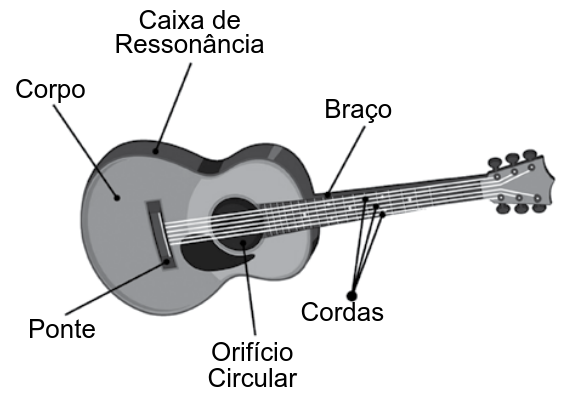
O violão acústico é um instrumento musical de cordas que não precisa de energia elétrica, que é geralmente feito de madeira, com um corpo oco, chamado de caixa de ressonância, e que possui um orifício circular na frente.
Sobre os conceitos de Física que envolvem esse instrumento musical, podemos afirmar corretamente que
Leia o texto e complete a frase.
A região de Essequibo, reivindicada I, engloba praticamente toda a área a oeste do Rio Essequibo, no território II. A região em questão tem cerca de 159 mil quilômetros quadrados (um pouco maior do que o estado do Ceará) tomados pelo bioma amazônico e é rica em recursos minerais e naturais.
Assinale a alternativa que completa, correta e respectivamente, o texto
Na Copa do Mundo de futebol masculino de 2022, participaram 32 países, dos quais 6 eram latino-americanos: Argentina, Brasil, Costa Rica, Equador, México e Uruguai.
Considere que dois países participantes dessa Copa serão sorteados, aleatoriamente, para disputar uma partida amistosa, então a probabilidade de os dois sorteados serem latino-americanos é
Em 1958, num congresso da Conmebol realizado no Rio de Janeiro, ficou definido que seria realizada uma competição continental com os clubes campeões nacionais de futebol da América do Sul. Em 1965, o torneio teve seu nome alterado para Copa Libertadores da América. O motivo da mudança tinha a ver com identidade regional, pois o novo nome homenageava um conjunto de líderes que se destacaram na história do continente.
O conjunto de líderes, a que o texto se refere, foi responsável
What´s the Difference Between the Metric and Imperial System?
While most of the world uses the International System of Units, aka the Metric System, Liberia, Myanmar and the United States are the only countries that have not officially adopted the Metric System. The United States has its own system, based on the old British Imperial System of inches and pounds.
What Is the Metric System?
The Metric System, or SI (Système International), is based off this original meter and currently the official system of measurement for almost all countries in Latin America, Asia, Africa, Europe and Oceania. The SI units–fundamental units not based on any other units–are meter, kilogram, second, ampere (electricity), kelvin (although Celsius is a more practical measurement for nonscientific applications), mole (chemistry), and candela (luminous intensity).
What Is the Imperial System?
The British Imperial System was the official system of weights and measures in the United Kingdom from 1824 until they adopted the Metric System in 1965. The Imperial System standardized measurements for units like pound and foot that had different meanings in different places.
Baseando-se no texto, assinale a alternativa correta.
What´s the Difference Between the Metric and Imperial System?
While most of the world uses the International System of Units, aka the Metric System, Liberia, Myanmar and the United States are the only countries that have not officially adopted the Metric System. The United States has its own system, based on the old British Imperial System of inches and pounds.
What Is the Metric System?
The Metric System, or SI (Système International), is based off this original meter and currently the official system of measurement for almost all countries in Latin America, Asia, Africa, Europe and Oceania. The SI units–fundamental units not based on any other units–are meter, kilogram, second, ampere (electricity), kelvin (although Celsius is a more practical measurement for nonscientific applications), mole (chemistry), and candela (luminous intensity).
What Is the Imperial System?
The British Imperial System was the official system of weights and measures in the United Kingdom from 1824 until they adopted the Metric System in 1965. The Imperial System standardized measurements for units like pound and foot that had different meanings in different places.
Das informações contidas no texto, é possível inferir corretamente que
A tirinha é um gênero que utiliza linguagem verbal e não verbal na construção de sentido.
Ao analisá-la, conclui-se corretamente que

Huge ancient lost city found in the Amazon
The discovery changes what we know about the history of people living in the Amazon. The houses and plazas in the Upano area in eastern Ecuador were connected by an astounding network of roads and canals. The area lies in the shadow of a volcano that created rich local soils but also may have led to the destruction of the society.
While we knew about cities in the highlands of South America, like Machu Picchu in Peru, it was believed that people only lived nomadically or in tiny settlements in the Amazon. "This is older than any other site we know in the Amazon. We have a Eurocentric view of civilisation, but this shows we have to change our idea about what is culture and civilisation," says Prof Stephen Rostain, director of investigation at the National Centre for Scientific Research in France, who led the research.
"It changes the way we see Amazonian cultures. Most people picture small groups, probably naked, living in huts and clearing land – this shows ancient people lived in complicated urban societies," says co-author Antoine Dorison.
The city was built around 2,500 years ago, and people lived there for up to 1,000 years, according to archaeologists. A network of straight roads and paths connected many platforms, including one that extended 25 km (16 miles).
Dr Dorison said these roads were the most striking part of the research. "The road network is very sophisticated. It extends over a vast distance, everything is connected. And there are right angles, which is very impressive," he says, explaining that it is much harder to build a straight road than one that fits in with the landscape.
The societies were clearly well-organised and interconnected and the Upano people living there probably mostly focussed on agriculture.
De acordo com o texto, o que pode ter levado à destruição da sociedade em questão foi
Huge ancient lost city found in the Amazon
The discovery changes what we know about the history of people living in the Amazon. The houses and plazas in the Upano area in eastern Ecuador were connected by an astounding network of roads and canals. The area lies in the shadow of a volcano that created rich local soils but also may have led to the destruction of the society.
While we knew about cities in the highlands of South America, like Machu Picchu in Peru, it was believed that people only lived nomadically or in tiny settlements in the Amazon. "This is older than any other site we know in the Amazon. We have a Eurocentric view of civilisation, but this shows we have to change our idea about what is culture and civilisation," says Prof Stephen Rostain, director of investigation at the National Centre for Scientific Research in France, who led the research.
"It changes the way we see Amazonian cultures. Most people picture small groups, probably naked, living in huts and clearing land – this shows ancient people lived in complicated urban societies," says co-author Antoine Dorison.
The city was built around 2,500 years ago, and people lived there for up to 1,000 years, according to archaeologists. A network of straight roads and paths connected many platforms, including one that extended 25 km (16 miles).
Dr Dorison said these roads were the most striking part of the research. "The road network is very sophisticated. It extends over a vast distance, everything is connected. And there are right angles, which is very impressive," he says, explaining that it is much harder to build a straight road than one that fits in with the landscape.
The societies were clearly well-organised and interconnected and the Upano people living there probably mostly focussed on agriculture.
A nova descoberta descrita no texto aponta que, na região Amazônica,
Huge ancient lost city found in the Amazon
The discovery changes what we know about the history of people living in the Amazon. The houses and plazas in the Upano area in eastern Ecuador were connected by an astounding network of roads and canals. The area lies in the shadow of a volcano that created rich local soils but also may have led to the destruction of the society.
While we knew about cities in the highlands of South America, like Machu Picchu in Peru, it was believed that people only lived nomadically or in tiny settlements in the Amazon. "This is older than any other site we know in the Amazon. We have a Eurocentric view of civilisation, but this shows we have to change our idea about what is culture and civilisation," says Prof Stephen Rostain, director of investigation at the National Centre for Scientific Research in France, who led the research.
"It changes the way we see Amazonian cultures. Most people picture small groups, probably naked, living in huts and clearing land – this shows ancient people lived in complicated urban societies," says co-author Antoine Dorison.
The city was built around 2,500 years ago, and people lived there for up to 1,000 years, according to archaeologists. A network of straight roads and paths connected many platforms, including one that extended 25 km (16 miles).
Dr Dorison said these roads were the most striking part of the research. "The road network is very sophisticated. It extends over a vast distance, everything is connected. And there are right angles, which is very impressive," he says, explaining that it is much harder to build a straight road than one that fits in with the landscape.
The societies were clearly well-organised and interconnected and the Upano people living there probably mostly focussed on agriculture.
Com base no texto, é correto afirmar que
Quéchua é uma família de línguas falada por diversos grupos étnicos, ao longo da região da cordilheira dos Andes. O quadro mostra os dez primeiros numerais nas línguas portuguesa e quéchua.
Nessa família de línguas, no que se refere ao seu sistema de numeração, existem algumas regras que são regulares e não variam. Por exemplo, se o nome de um algarismo está
• antes do numeral 10, isso indica uma multiplicação: pusac chunca é oito vezes dez, ou seja, 80;
• depois do numeral 10, isso indica uma adição: chunca pusac é dez mais oito, ou seja, 18.
Seguindo a lógica de formação numérica apresentada no texto, o numeral trinta e nove (39), na língua quéchua, é

Os queros são descendentes de uma linhagem inca que, até hoje, fala a língua quéchua e mantém a tradição do culto à Pachamama (Mãe Terra) e aos Apus (espíritos das montanhas). São camponeses e pastores que valorizam o amor, o respeito e a comunicação com a terra, trazendo consigo o Sumak Kausay, o "Bem-Viver"; o Ayni, a reciprocidade com a vida; e o Ayllu, a compreensão da vida coletiva e em comunidade.
Segundo o texto, é correto afirmar que
Leia o texto que um missionário dominicano escreveu aos reis da Espanha em 1565.
Todas as guerras que chamamos de conquista foram e são injustíssimas. Nós usurpamos todos os reinos e senhorios das Índias. As encomiendas e repartimentos de índios são cruéis e tirânicos, todos os que se beneficiam delas estão sempre em pecado mortal e, se não renunciarem a essas práticas, não poderão se salvar. Todo o ouro, a prata, as pérolas e outras riquezas que foram à Espanha são roubados e, se não forem devolvidos, quem os tomou não poderá se salvar. Todas as pessoas de quem roubamos, em qualquer parte, têm direito adquirido de nos fazer guerra justíssima e este direito valerá até o dia do Juízo Final.
Segundo o texto,